




📑 Table of Contents
1. How Did CPP, OPP, BOPP, and MOPP Films Get Their Names?
PP film is a general term referring to polypropylene film. All four types—CPP, OPP, BOPP, and MOPP—are made from the same PP plastic raw material. The different names arise from different manufacturing processes, particularly film stretching techniques.
2. Why Are Plastic Films Stretched?
Stretching aligns polymer molecules in a specific direction. The main purposes are:
- Improved Dimensional Stability – Maintains shape under varying conditions.
- Enhanced Mechanical Properties – Increases density, tensile strength, and toughness.
- Increased Gloss and Transparency – Superior optical properties.
- Better Gas Barrier Properties – Reduced gas permeability (moisture & oxygen).
3. What Is the Difference Between PP Film and OPP Film?
PP film is a broad category that encompasses all polypropylene-based films. OPP film is a specific type of PP film that has undergone uniaxial stretching in the TD direction.
Conclusion: PP film is a broad category; OPP film is a specific stretched PP film product.
4. How Do You Distinguish Between OPP Film and CPP Film?
The primary distinction between CPP film and OPP film is whether or not the film is stretched.
✅ CPP Film (Cast)
- No stretching (cast directly)
- Softer, more flexible
- Higher tear & impact resistance
- Excellent heat-sealability
- Low moisture permeability
- Highly customizable (anti-fog, anti-static, etc.)
✅ OPP Film (Oriented)
- Stretched in TD direction
- Stiffer, more rigid
- Higher mechanical strength
- Limited heat-sealability
- Higher gloss & transparency
- Better gas barrier properties
5. What Are the Differences Between OPP, BOPP, and MOPP Films?
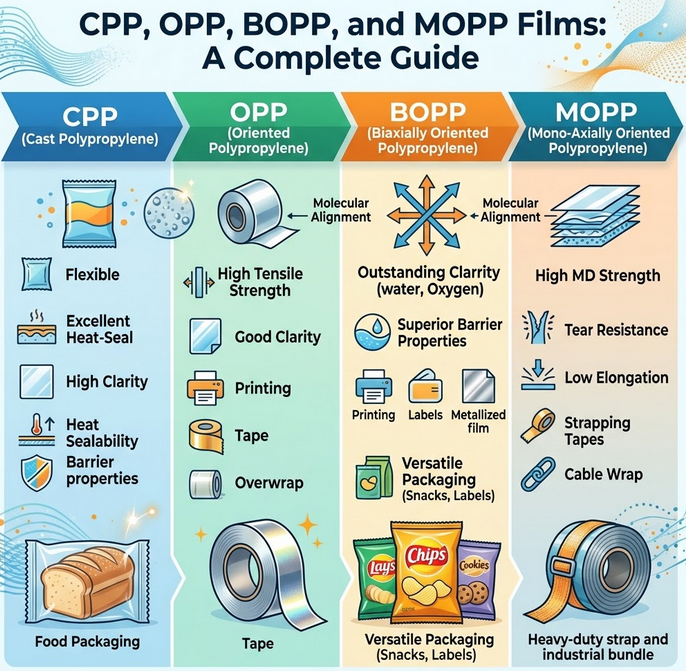
OPP, BOPP, and MOPP are all stretched PP films, but they differ in how and in which directions they are stretched.
6. Individual Film Profiles: Getting to Know Each Material
Beyond their abbreviations, each film has a distinct “personality” defined by its manufacturing route. Here is a closer look at each one.
🔹 CPP Film
Cast Polypropylene (Non-oriented)
- Process: Melt-extruded through a T-die and rapidly quenched on a chilled drum. Zero stretching means the molecules remain randomly arranged.
- Personality: Soft, supple, and highly transparent. Think of it as the “flexible all-rounder.”
- Superpower: Excellent heat sealability – it is the go-to inner sealing layer.
- Trade-offs: Lower mechanical strength and stiffness compared to stretched films. Slightly hazy at thicker gauges.
- Go-to Applications: Lamination film (inner sealant), garment bags, flower wrapping, and retort pouches (when combined with nylon or foil).
🔹 OPP Film
Oriented Polypropylene (TD-oriented)
- Process: Cast film is stretched in the Transverse Direction (TD) only. Molecular orientation happens in just one axis.
- Personality: Stiffer and glossier than CPP, with an uneven strength profile (stronger across the width).
- Superpower: High clarity and surface smoothness – excellent for high-speed printing and labeling.
- Trade-offs: Very poor heat sealability; cannot be used as a sealing layer. Tears easily in the MD direction.
- Go-to Applications: Adhesive tape backings, shrink wrap, label film, and outer webs for light packaging.
🔹 BOPP Film
Biaxially Oriented Polypropylene (MD+TD oriented)
- Process: Stretched in both Machine (MD) and Transverse (TD) directions simultaneously or sequentially. This creates a balanced, cross-hatched molecular network.
- Personality: The “workhorse” of flexible packaging. Crystal clear, stiff, and dimensionally stable.
- Superpower: Balanced mechanical & barrier performance. Light transmittance ≥90%, gloss ≥85%. Excellent water vapor barrier.
- Trade-offs: Poor heat sealability (requires a sealing layer). Higher cost than CPP due to the complex stretching process.
- Go-to Applications: Snack food wrappers (chips, biscuits), cigarette packaging, metallized films (for premium barrier), and outer lamination layers.
🔹 MOPP Film
Monoaxially Oriented Polypropylene (MD-oriented)
- Process: Stretched in the Machine Direction (MD) only. Molecules align like fibers along the length of the roll.
- Personality: The “directional specialist.” Extremely strong lengthwise but deliberately weak across the width.
- Superpower: High tensile strength in MD + clean tear in TD. This “splitability” is perfect for strapping.
- Trade-offs: Very unbalanced strength. Not suitable for general packaging where omnidirectional strength is needed.
- Go-to Applications: Bundling tapes, strapping bands, tire cord liners, and industrial release liners.
7. Multi-layer Laminations: Combining Strengths for Real-World Applications
In the real world, you rarely use a single film alone. Why? Because no single film does everything well. BOPP offers brilliant strength and clarity but cannot seal itself. CPP seals beautifully but lacks stiffness. By laminating them together (with or without adhesive), we create composite structures that leverage each layer’s superpower.
Why Laminate?
- Outer layer (Printing/Strength): Usually BOPP or PET. Provides mechanical protection, high gloss, and printability.
- Middle layer (Barrier): Often aluminum foil, VMPET (metallized), or EVOH. Provides moisture/oxygen/light barrier.
- Inner layer (Sealant): Almost always CPP or PE. Provides the heat-sealable layer that forms the bag’s seal.
Common PP-based Laminate Structures
| Laminate Structure | Layer Roles | Why This Combination? |
|---|---|---|
| BOPP / CPP |
Outer: BOPP (Strength/Print) Inner: CPP (Sealant) |
The classic dry-food duo. BOPP gives excellent shelf appeal (high gloss, crisp graphics), while CPP provides a strong, easy-tear heat seal. ✅ Biscuits, candies, dried snacks |
| BOPP / CPP / PE |
Outer: BOPP Middle: CPP (Bonding/Split) Inner: PE (Sealant/Strength) |
Adding PE (polyethylene) as the innermost layer dramatically improves impact resistance and low-temperature sealing (PE seals at lower temperatures than CPP). Used for heavier contents. ✅ Frozen foods, liquid pouches, heavy-duty bags |
| BOPP / VMPET / CPP |
Outer: BOPP Middle: VMPET (Barrier) Inner: CPP |
The “premium shelf-life” structure. VMPET (metallized PET) provides a high oxygen/moisture barrier and stunning metallic aesthetics, while BOPP protects the metal coating from scratches. ✅ Coffee, spices, premium snacks (odor-proof) |
| BOPP / AL / CPP |
Outer: BOPP Middle: Aluminum Foil Inner: CPP |
The ultimate hermetic barrier. Aluminum foil provides a near-zero OTR/WVTR. BOPP provides the tear strength, CPP provides the seal. Used for retort pouches and pharmaceuticals. ✅ Retort meals, medical devices, high-end pet food |
8. One Chart: Understanding the Differences Between CPP, OPP, BOPP, and MOPP Films
Here is your complete at-a-glance comparison:
| Property | CPP | OPP | BOPP | MOPP |
|---|---|---|---|---|
| Full Name | Cast Polypropylene | Oriented PP | Biaxially Oriented PP | Monoaxially Oriented PP |
| Stretching | None | TD only | MD + TD | MD only |
| Flexibility | High (soft) | Moderate | Low (stiff) | Moderate |
| Heat Sealability | ⭐ Excellent | Limited | Poor | Poor |
| Tear/Impact Resistance | High | Moderate | Moderate | High (MD) / Low (TD) |
| Gas Barrier | Good | Better | Best | Good |
| Common Lamination Role | Inner Sealant | Outer / Tape | Outer / Middle | Industrial / Tape |
🎯 Final Verdict
All four films—CPP, OPP, BOPP, and MOPP—are made from the same polypropylene (PP) raw material. Their differences arise primarily from whether and how the film is stretched:
- CPP is not stretched — offers excellent heat sealability, flexibility, and impact resistance. The go-to inner sealant.
- OPP is stretched in TD — improves mechanical properties and gloss in one direction. Great for tapes and labels.
- BOPP is stretched in both MD and TD — provides balanced strength, superior transparency, and the best barrier. The king of outer packaging.
- MOPP is stretched in MD — offers high tensile strength in one direction and easy tearability in the other, ideal for industrial strapping.
In practice, you rarely use them alone. Multi-layer lamination (e.g., BOPP/CPP, BOPP/CPP/PE) combines the stiffness of BOPP with the sealability of CPP, often adding a barrier layer (VMPET or AL) in between. Understanding these roles helps packaging engineers design structures that perfectly balance cost, shelf life, and mechanical integrity.



Leave a Reply