




Laminated packaging films sit at the center of almost every modern flexible pack. From coffee pouches and pet food bags to medical pouches and frozen meat packs, these multi-layer structures combine several films into one high-performance solution. For buyers, packaging engineers, and brand owners, understanding how laminates work makes it much easier to choose the right structure, control costs, and work efficiently with your packaging manufacturer.
This complete guide covers everything you need to know about laminated film — what it is, how it’s made, common structures, the function of each layer, how it compares to co-extruded film, key applications, and how to select the right laminated film for your needs.
📑 Table of Contents
What Is Laminated Film?
A laminated film is a multilayer structure created by bonding two or more layers of material together—typically using adhesives or extrusion—to form a single composite film that combines the strengths of each individual layer. Instead of trying to get all required properties from a single film, you combine the strengths of different substrates in one engineered structure.
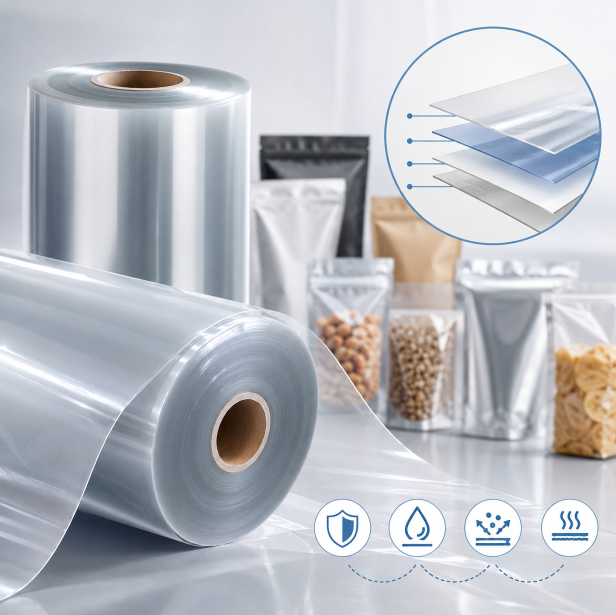
Lamination (bonding together) of two or more films improves the appearance, barrier properties, or mechanical strength of a package. Laminated films are designed to produce flexible packaging for the food, pharmaceutical, pet food, and other industrial segments.
The laminated film is typically supplied as rollstock (laminated film roll) to converters or directly to brand owners, then printed, slit, and converted into pillow bags, stand-up pouches, lidding films, sachets, or high-barrier bags.
How Is Laminated Film Made?
There are two primary methods for manufacturing laminated films: adhesive lamination and extrusion lamination.
Adhesive Lamination (Dry & Solventless)
In adhesive lamination, an adhesive solution is applied to one of the film webs. The adhesive can be solvent-based, solventless, or water-based. In dry lamination, the adhesive is applied to one substrate, dried with hot air, and then the other substrate is layered onto the first one by a hot compression nip roll. This method allows for bonding a wide variety of materials that may have different melting points or processing temperatures.
Extrusion Lamination
In extrusion laminating, an extruder is used to melt and apply a molten resin—usually polyethylene—between the web materials being laminated. The molten polymer acts as both the adhesive and an additional functional layer. The materials are then passed through a chill roll to cool and solidify the structure.
The Lamination Process Flow
A typical lamination process includes:
- Substrate unwinding – individual film rolls are fed into the line.
- Adhesive application or extrusion – the bonding agent is applied.
- Nip roll compression – layers are pressed together under heat and pressure.
- Cooling – the laminated structure is cooled and set.
- Rewinding – the finished laminated film is wound into rolls for further processing, such as printing or bag making.
The development of laminated films has made significant improvements to film performance, particularly in food packaging where preservation and shelf appeal are greatly enhanced.
Common Laminated Film Structures
Laminated films can be engineered in countless combinations. Below are the most common structures used in flexible packaging.
PET/PE Laminated Film
Structure: Polyester (PET) outer layer + Polyethylene (PE) inner layer.
- PET layer provides stiffness, clarity, dimensional stability, printability, and puncture resistance.
- PE layer provides heat sealing, flexibility, and moisture resistance.
Applications: Frozen meals, refrigerated foods, snack foods, dry goods, and general-purpose flexible packaging.
Why it works: This is the most common laminate structure because it balances performance and cost effectively. PET offers strength and a premium printing surface, while PE delivers the sealability needed to form bags and pouches.
PET/AL/PE Laminated Film
Structure: PET outer layer + Aluminum foil (AL) middle layer + PE inner layer.
- PET layer provides mechanical strength, heat resistance, and a print-friendly surface.
- Aluminum foil layer acts as the main barrier to light, moisture, oxygen, and odours.
- PE layer provides heat sealability and flexibility.
Applications: Coffee and tea, snack foods, pharmaceuticals, pet food, and products requiring high barrier protection.
Why it works: Aluminum foil provides a near-total barrier to oxygen, moisture, light, and volatile compounds, with an oxygen transmission rate (OTR) approaching 0 cm³/m²/day. This makes PET/AL/PE the structure of choice for products requiring long ambient shelf life.
PET/CPP Laminated Film
Structure: PET outer layer + Cast Polypropylene (CPP) inner layer.
- PET layer provides stiffness, clarity, and printability.
- CPP layer provides heat sealing with a wider sealing window and better hot-tack than PE.
Applications: Pasta, bakery packaging, and snack food applications requiring higher heat resistance than PE can provide.
Other Common Structures
| Structure | Key Features | Common Applications |
|---|---|---|
| BOPP/PE | Lightweight, lower cost than PET/PE | Confectionery, snacks |
| PA/PE | Flexibility at low temperatures, gas barrier | Fresh meat, vacuum packs |
| PET/AL/CPP | High barrier + heat resistance | Ready meals, retort packaging |
| OPP/VMPET/PE | Metallized barrier with visual appeal | Snacks, pet food |
The Function of Each Layer
When you look at a typical laminate cross-section, you will usually find the following functional layers:
Outer Layer (Printing and Stiffness)
Common materials: PET, BOPP.
- Carries graphics and branding.
- Protects the inks from abrasion and handling.
- Provides mechanical strength and dimensional stability.
- Gives the package its “hand feel” and aesthetic appeal.
Why PET is preferred: PET is dimensionally stable at elevated temperatures, provides excellent print reproduction for rotogravure and flexographic processes, and resists puncture.
Middle / Barrier Layer
Common materials: Aluminum foil (AL), metallized PET (VMPET), EVOH, nylon (PA).
- Blocks oxygen, moisture, light, and aroma transmission.
- Controls the shelf life of the packaged product.
- May provide additional mechanical strength.
Barrier Performance Comparison:
- Aluminum foil: OTR approaches 0 cm³/m²/day; near-zero MVTR.
- Metallized films: OTR typically 0.1–1.5 cm³/m²/day; MVTR 0.1–0.5 g/m²/day.
- EVOH: OTR as low as 0.1–0.5 cm³/m²/day (but moisture-sensitive).
Inner Sealing Layer
Common materials: PE, CPP.
- Contacts the product directly.
- Provides hermetic heat sealing.
- Offers hot-tack strength (seal strength while still hot).
- Contributes puncture resistance and flexibility.
Why PE is preferred: PE provides excellent heat sealability, flexibility, and moisture resistance at a competitive cost.
Adhesive / Tie Layer
- A very thin layer that bonds the films together.
- Keeps the laminate stable over time.
- Ensures the structure does not delaminate during use.
Laminated Film vs Co-Extruded Film
A film made by overlapping two or more types of films is called a multilayer film. There are two main manufacturing methods: co-extrusion and lamination.
| Aspect | Laminated Film | Co-Extruded Film |
|---|---|---|
| Bonding method | Layers bonded with adhesive or extrusion lamination | Layers fused together during extrusion; no adhesive used |
| Layer compatibility | Can bond dissimilar materials (e.g., plastic to foil) | Limited to polymers that can be co-extruded together |
| Thickness | Generally thicker | Thinner; closer to monolayer films |
| Production speed | Slower, more complex | More agile production scale |
| Cost | Higher | More cost-effective |
| Barrier performance | Excellent; can include foil barriers | Good; may use EVOH or other barrier polymers |
| Recyclability | More challenging due to mixed materials | Often more recyclable, especially mono-material structures |
Key takeaway: Choose laminated film when you need to combine materials that cannot be co-extruded together (such as plastic with aluminum foil), require the absolute highest barrier performance, or need specific aesthetic effects. Choose co-extruded film when cost is a primary concern, high-speed production is needed, or recyclability is a priority.
Common Applications of Laminated Packaging Film
Laminated films are used across a wide range of industries:
Food Packaging
- Coffee and tea: PET/AL/PE structures provide the oxygen and aroma barrier needed to preserve freshness.
- Snack foods and nuts: Metallized laminates offer high barrier at lower cost.
- Frozen foods: PET/PE laminates provide heat resistance and seal integrity.
- Fresh meat and seafood: PA/PE or PA/EVOH/PE structures offer gas barrier and low-temperature flexibility.
- Ready meals and retort pouches: PET/AL/CPP can withstand sterilization temperatures.
- Spices, powders, and instant drinks: Paper/PE/Aluminum foil structures.
Pharmaceutical and Medical Packaging
- Unit-dose pouches and sachets.
- Blister packaging lidding.
- Medical device packaging.
Other Industrial Applications
- Pet food: High-barrier laminates for extended shelf life.
- Personal care: Cosmetic packaging, wipes, and towels.
- Industrial components: Requiring high barrier protection.
- Semiconductors and electronic components: Moisture and static protection.
How to Choose the Right Laminated Film
Selecting the right laminated film is a critical decision that directly impacts product safety, shelf life, brand perception, and operational efficiency. Here’s a systematic approach:
1. Start with Your Product and Process
- What are you packaging? Food, pharmaceutical, industrial?
- What is the product’s sensitivity? Oxygen, moisture, light, aroma?
- What is the required shelf life?
- What is your filling line setup? Form-fill-seal? Vertical or horizontal?
- Does the package need sterilization or retort?
2. Define Barrier Requirements
| Requirement | Recommended Structure |
|---|---|
| Maximum barrier (oxygen, moisture, light) | PET/AL/PE or PET/AL/CPP |
| High oxygen barrier, transparent | PET/EVOH/PE |
| High moisture barrier, low cost | BOPP/PE |
| Aroma retention | PET/AL/PE or metallized structures |
| Puncture resistance + flexibility | PA/PE |
3. Consider Aesthetic and Branding Needs
- Premium graphics: PET or BOPP outer layer for high-quality rotogravure or flexo printing.
- Metallic look: Metallized films or foil laminates.
- Tactile effects: Embossed or textured finishes.
4. Evaluate Cost and Sustainability
- Cost: Co-extruded structures are generally more cost-effective than adhesive laminates.
- Recyclability: Consider mono-material structures or recyclable laminates where possible.
- Regulatory compliance: Ensure FDA approval and food safety certifications for food-contact applications.
5. Work with a Trusted Supplier
Communicate clearly with your laminated packaging film supplier. A good supplier will help you select the right structure, offer customization options, provide samples for testing, and ensure regulatory compliance (FDA, SGS, ISO).
Conclusion
Laminated film is one of the most versatile and essential materials in modern flexible packaging. By combining different materials into a single engineered structure, laminates deliver performance that no single film can achieve alone—from superior barrier protection and mechanical strength to stunning visual appeal and reliable heat sealability.
Understanding the fundamentals—what laminated film is, how it’s made, the function of each layer, the differences between structures, and how to choose the right one—empowers you to make better packaging decisions that protect your products, enhance your brand, and optimize your costs.
By working closely with an experienced packaging partner, you can tailor the laminated film structure precisely to your product’s unique requirements, ensuring both performance and efficiency on your production line.



Leave a Reply