



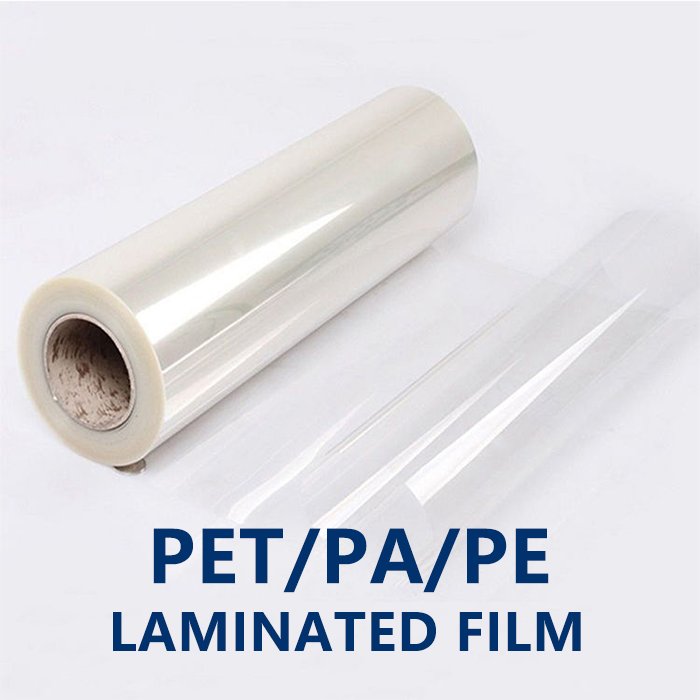
Description
PET/PA/PE Laminated Film is a three-layer flexible packaging material consisting of PET, polyamide (PA/nylon) and PE. The combination is designed for packaging applications where mechanical strength, toughness and puncture resistance are important in addition to heat-sealing performance.
PET provides a strong and dimensionally stable outer layer, PA contributes toughness and resistance to puncture and mechanical stress, while PE provides the inner heat-sealing surface.
This structure is particularly useful when a conventional PET/PE laminate does not provide the desired level of mechanical durability for the intended packaging application.
What Is PET/PA/PE Laminated Film?
PET/PA/PE is a three-layer laminated film structure:
PET / PA / PE
PA is short for Polyamide and is also commonly referred to as Nylon in flexible packaging applications.
- PET: provides the outer layer with strength, dimensional stability and a suitable surface for printing.
- PA: provides toughness, flexibility and improved resistance to puncture and mechanical stress.
- PE: provides the inner heat-sealing layer and contributes flexibility.
The final performance depends on the selected material grades, layer thicknesses, lamination method and processing conditions.
How the PET/PA/PE Structure Works
PET Outer Layer
PET provides the outer support layer of the laminate. Its strength and dimensional stability can help the film maintain its structure during printing, converting, filling and transportation.
The PET surface can also be used for suitable printing applications depending on the selected film grade and printing process.
PA Middle Layer
The PA layer is the key functional difference between PET/PA/PE and simpler PET/PE structures.
Polyamide provides high toughness and good resistance to mechanical stress. It can improve the laminate’s resistance to puncture and help the packaging withstand demanding handling conditions.
PA can therefore be useful for packaging products with sharp edges, irregular shapes or higher mechanical demands.
PE Inner Layer
PE forms the inner sealing layer of the laminate. It provides the heat-sealing surface required for suitable bag and pouch manufacturing processes.
The PE layer can be selected according to the required sealing temperature, sealing strength and packaging equipment.
In simple terms:
- PET: outer strength and dimensional stability
- PA: toughness and puncture resistance
- PE: heat sealing and flexibility
PET/PA/PE Three-Layer Structure
| Layer | Material | Primary Function |
|---|---|---|
| Outer Layer | PET | Provides strength, dimensional stability and the outer packaging surface. |
| Middle Layer | PA / Nylon | Provides toughness and improved resistance to puncture and mechanical stress. |
| Inner Layer | PE | Provides heat-sealing performance and contributes flexibility. |
Why Add PA to a PET/PE Laminate?
PET/PE is suitable for many general flexible packaging applications, but some products place greater mechanical demands on the package.
Adding a PA layer can improve the laminate’s resistance to puncture, impact and mechanical stress. This makes PET/PA/PE worth considering when the package needs to withstand more demanding handling or when the packaged product itself could damage a conventional plastic laminate.
The PA layer also provides a useful balance of toughness and flexibility without requiring the entire structure to be made from a single material.
Key Benefits of PET/PA/PE Laminated Film
| Feature | Benefit |
|---|---|
| Puncture Resistance | The PA layer improves resistance to puncture and mechanical damage. |
| High Toughness | PA provides toughness for demanding handling and packaging conditions. |
| Outer Strength | PET contributes mechanical strength and dimensional stability. |
| Heat Sealing | PE provides the inner heat-sealing surface. |
| Flexible Structure | The combination of PET, PA and PE provides a balance of strength and flexibility. |
PET/PA/PE vs. PET/PE
The main difference is the PA layer. PET/PE is a simpler two-layer structure, while PET/PA/PE introduces polyamide to improve mechanical durability.
| Feature | PET/PA/PE | PET/PE |
|---|---|---|
| Structure | PET / PA / PE | PET / PE |
| Number of Layers | 3 | 2 |
| Puncture Resistance | Higher potential due to PA layer | Depends on film grade and thickness |
| Mechanical Durability | Suitable for more demanding applications | Suitable for general flexible packaging applications |
| Heat Sealing | PE | PE |
Applications of PET/PA/PE Laminated Film
PET/PA/PE can be considered for packaging applications where higher mechanical durability is important.
- Flexible food packaging
- Meat and seafood packaging
- Frozen food packaging
- Pet food packaging
- Products with sharp or irregular edges
- Heavy-duty flexible packaging
- Industrial packaging
- High-strength pouches and bags
For food and other regulated applications, the selected materials and finished packaging should meet the applicable requirements for the intended market and product.
Moisture and Gas Barrier Considerations
PET/PA/PE can provide useful mechanical performance, but the structure should not automatically be described as an aluminum-foil-level high-barrier laminate.
PA can provide good barrier characteristics against certain gases, while PE provides moisture resistance and heat sealing. The actual oxygen transmission rate, moisture vapor transmission rate and overall barrier performance depend on the specific material grades, thicknesses and laminate design.
If extremely high barrier protection against light, oxygen and moisture is required, a structure containing aluminum foil or a suitable metallized barrier film may be more appropriate.
Custom PET/PA/PE Laminated Film
| Customization | Available Options |
|---|---|
| Film Structure | PET / PA / PE |
| Total Thickness | Customized according to application requirements |
| Film Width | Customized according to converting requirements |
| Roll Length | Customized according to order requirements |
| Printing | Custom printing according to packaging artwork |
What Information Should You Provide for a Quote?
- Packaging application
- Required film structure
- Total film thickness
- Film width
- Roll length
- Printing requirements
- Finished bag or pouch dimensions
- Required puncture resistance
- Sealing requirements
- Estimated order quantity
Frequently Asked Questions
What is PET/PA/PE laminated film?
PET/PA/PE is a three-layer flexible packaging film consisting of PET, polyamide and PE. PET provides outer strength, PA improves toughness and puncture resistance, and PE provides the heat-sealing layer.
What does PA mean in PET/PA/PE?
PA means polyamide. In flexible packaging, PA is also commonly called nylon.
Why is PA used in flexible packaging?
PA is used when improved toughness, puncture resistance and mechanical durability are required. It can help the packaging withstand demanding handling conditions.
Is PET/PA/PE heat sealable?
Yes. The PE inner layer provides the heat-sealing surface for suitable packaging applications.
Is PET/PA/PE suitable for food packaging?
It can be used for suitable food packaging applications when the selected materials, adhesives, inks and finished packaging meet the applicable requirements for the intended product and market.
Can PET/PA/PE be customized?
Yes. Film thickness, width, roll length, printing and other specifications can be customized according to the packaging application and converting requirements.
Request a Quote for PET/PA/PE Laminated Film
If you are sourcing PET/PA/PE laminated film for flexible packaging that requires greater mechanical durability, send ZXCOOL your required structure, thickness, width, roll length, printing requirements and intended application.
Contact ZXCOOL to discuss your PET/PA/PE laminated film requirements and request a customized quotation.

Kenichi –
We’re a small food processor in Kanagawa, packing tsukudani (simmered small fish) and dried sardines. We used to use a standard PET/PE 2-layer film, but the sharp bones kept poking tiny holes through the bags during transport—customer complaints were piling up.
Switched to this PET/PA/PE (nylon layer) three months ago. Pinholes are practically gone. The PA layer really does the job—it handles sharp edges without tearing. Yes, it’s a bit pricier than our old film, but the drop in product loss makes up for it. Seal strength is solid, and it ran on our existing vertical filler without major issues.
One tip: if your machine is older, you may need to reduce tension slightly—we saw a few wrinkles at first, but after that tweak, smooth sailing.