




📑 Table of Contents
1. What Are ESD Bags?
ESD bags (Electrostatic Discharge bags), also known as anti-static packaging, are specialized packaging materials designed to protect sensitive electronic components from damage caused by electrostatic discharge. Electrostatic discharge occurs when a static charge builds up on a surface and suddenly releases, potentially destroying or degrading sensitive electronic components like PCBs, semiconductors, integrated circuits, and microchips.
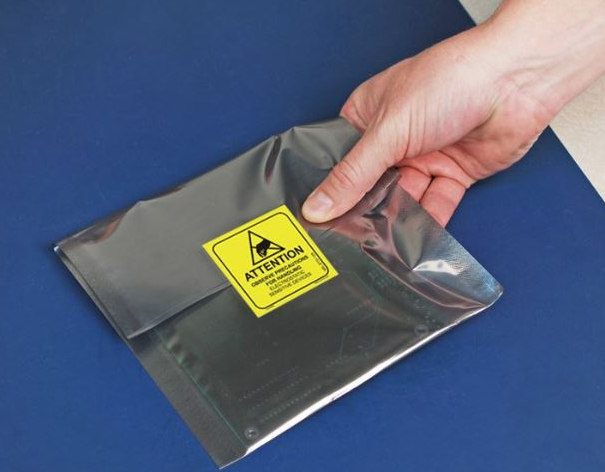
ESD bags are essential across multiple industries, including semiconductor manufacturing, PCB assembly, aerospace, medical electronics, and any environment where sensitive electronic devices are handled, stored, or shipped. They control static electricity on the packaging surface and/or shield contents from external electrostatic discharge events.
2. How Do ESD Bags Work?
ESD bags work through two primary mechanisms: static dissipation and static shielding.
Static Dissipation works by preventing the buildup of static electricity on the bag’s surface. Materials with dissipative properties feature either a topical anti-static coating or internal chemical additives that allow static charges to safely dissipate to ground rather than accumulating. This is how basic anti-static bags (like pink poly bags) operate.
Static Shielding provides a higher level of protection. Static shielding bags are constructed using a multi-layer design that creates a Faraday cage effect. A Faraday cage is a protective barrier that blocks external electrostatic fields from reaching the contents inside. The metalized layer in these bags prevents damaging electrostatic fields from penetrating, while the specially processed inner layer minimizes tribocharging (static generated by friction).
In order to provide full ESD protection, the bag must be properly sealed—no seal means no guarantee of protection. Items inside a properly sealed ESD bag cannot be damaged by electrostatic discharge because the bag creates an effective Faraday shield.
3. What Are ESD Bags Made Of?
The materials used in ESD bags vary depending on the type and level of protection required:
- Polyethylene (PE): The most common base material for ESD bags. Anti-static bags are typically constructed from polyethylene plastic. Anti-static additives are either built into the film’s layers (more reliable) or applied topically.
- Polyethylene Terephthalate (PET): A common material used in anti-static bags, typically colored pink. PET versions of anti-static bags provide dissipative properties through a coating that prevents static charge buildup.
- Multi-Layer Laminates (Static Shielding Bags): Static shielding bags use a sophisticated multi-layer construction:
- Inner layer: Static dissipative polyethylene
- Middle layer: Thin metallized shielding layer (typically aluminum)
- Outer layer: Polyester with a static dissipative coating
- Metal-In vs Metal-Out Construction: There are two types of static shielding bag constructions. Metal-in (the metal layer buried inside) is the most commonly used, providing excellent ESD protection at a cost-effective price. Metal-out (metal layer closer to the outside surface) provides lower resistance readings and is used in critical electronics applications like disk drive manufacturing.
- Moisture Barrier Bags: These are constructed from multiple layers of metalized polyester (sometimes nylon, foil, and polyethylene laminates). They are thicker than standard shielding bags and provide excellent puncture resistance.
4. Are ESD Bags Conductive?
The answer depends on the type of ESD bag:
- Static shielding bags (metallized bags) are conductive. They operate using a layer of conductive metal and a dielectric plastic layer to create a Faraday cage effect. These bags have both conductive and dissipative properties—they feature a dissipative outer section and a conductive shielding layer.
- Anti-static bags (pink polyethylene bags) are not conductive. They are dissipative materials that prevent static charge buildup but do not provide shielding against external electrostatic discharge.
- Conductive bags (often black) are made from polyethylene loaded with carbon, making them truly conductive. These are lower in cost than shielding bags but offer more protection than basic anti-static bags.
According to the ANSI/ESD S541 standard, static shielding bags have a high resistance inner layer with a conductive layer around it, which is how they achieve discharge shielding. Surface resistance for shielding bags typically ranges from 10⁴ to <10¹¹Ω.
5. ESD Bag Types: A Complete Breakdown
🔹 Anti-Static Bags (Pink Bags)
Description: The most basic and economical ESD packaging option. Typically pink in color, made from polyethylene with anti-static additives.
How They Work: Anti-static bags prevent static electricity from building up on the bag itself through dissipative properties. They will not generate or hold a triboelectric charge.
Limitations: They do NOT provide Faraday cage protection—a static charge can enter the bag. If an electrostatic discharge strikes the outside of a pink bag, the energy can pass through and potentially damage the component inside.
Best Uses: Packaging non-ESD-sensitive parts used in electronics manufacturing (like nuts, bolts, manuals), or storing ESD-sensitive items within an ESD Protected Area (EPA) where external risks are already controlled. They should never be used as the only packaging to protect electronic components from electrostatic discharge.
Color: Typically pink (the pink coloring is an additive to denote the bag is made of dissipative material).
🔹 Static Shielding Bags (Silver/Metallized Bags)
Description: The industry standard for transporting and storing sensitive PCBs and semiconductor devices. They are typically silver in color.
How They Work: Constructed from multiple layers including aluminum shielding, polyester, and static dissipative polyethylene, these bags create a Faraday cage that protects components from static charges both inside and outside the bag.
Protection Level: Highest level of ESD protection for packaging applications.
Best Uses: Storage and transport of electronic devices susceptible to static discharge. Required by the US military for all electronic components (circuit boards, hard drives, sound cards, etc.) under MIL-PRF-81705 specifications.
Closure Options: Available as flat bags, ziplock bags, tubing, and roll stock sheeting; open-top, heat-sealable, self-sealing, and reclosable zipper styles.
🔹 Conductive Bags (Black Bags)
Description: Made from polyethylene loaded with carbon, these bags are truly conductive.
How They Work: The conductive outer layer provides faster charge dissipation when the bag touches a grounded surface.
Protection Level: Higher than anti-static bags but lower than shielding bags.
Best Uses: Packaging applications where a conductive container is needed; often used for shipping components from an ESD area to a non-ESD area. However, note that black polyethylene bags only prevent about 30% of charge and lack a dielectric layer to isolate components.
🔹 Moisture Barrier Bags (Dri-Shield Bags)
Description: Specialized ESD bags designed for vacuum sealing applications that provide protection against moisture, corrosion, electrostatic discharge, EMI, and physical damage.
How They Work: Constructed of multiple layers of metalized polyester (and sometimes nylon and foil) with a low moisture vapor transmission rate (MVTR). These bags shield from electromagnetic interference (EMI) and radio frequency interference (RFI) as well as static.
Protection Level: Highest overall protection—combines dissipation, anti-static properties, static shielding, and moisture vapor barrier.
Best Uses: Long-term storage of moisture-sensitive items, shipping sensitive components that require protection from both ESD and humidity. Commonly used thickness is 3.6 mil (Dri-Shield 2000 series).
6. Anti-Static Bag vs ESD Bag: What’s the Difference?
This is one of the most common points of confusion. The terms are often used interchangeably, but they are not the same.
| Feature | Anti-Static Bag | ESD Bag (Static Shielding) |
|---|---|---|
| Color | Typically pink | Typically silver/metallized |
| Material | Polyethylene with anti-static additives | Multi-layer: PE, polyester, aluminum shielding |
| Function | Prevents static buildup on the bag | Prevents static buildup + shields contents from ESD |
| Faraday Cage | No | Yes |
| Protects from external ESD | No | Yes |
| Best for | Non-sensitive parts, use within EPA | Sensitive electronic components, shipping |
Anti-static materials ONLY prevent the build-up of static electricity. The material itself will not generate or hold a triboelectric charge. However, these materials do NOT protect from electrostatic discharge (ESD).
Static shielding bags (properly called ESD bags) prevent static buildup AND protect from electrostatic discharge. They create a Faraday cage that protects components from static charges both inside and outside the bag.
Many manufacturers incorrectly call pink polymer bags “ESD bags,” which has led to many circuit boards being improperly packaged. Pink anti-static bags are NOT ESD shielded bags.
7. How to Choose the Right ESD Bag
Choosing the right ESD bag depends on several factors:
Consider Your Product:
- Is it ESD-sensitive? If yes, you need at minimum a static shielding bag.
- Is it moisture-sensitive? Consider moisture barrier bags.
- Is it non-sensitive? Anti-static bags may be sufficient.
Consider Your Environment:
- Inside an ESD Protected Area (EPA): Anti-static bags may be acceptable for ESD-sensitive items.
- Shipping outside an EPA: ESD-sensitive items must be placed in shielding bags or conductive containers.
- Long-term storage: Moisture barrier bags provide the best protection.
Consider Standards and Regulations:
- The US military requires all electronic components to meet MIL-PRF-81705 specifications for static shielding materials.
- Common standards include ANSI/ESD S20.20, EIA 541, and EIA 625.
- Always verify product documentation against the Qualified Product List for MIL-PRF-81705.
Consider Bag Features: Thickness (ranges from 2-8 mil for anti-static bags), closure (open-top, ziplock, heat-sealable), and size (available in a wide range of dimensions).
8. Common Misconceptions About ESD Bags
❌ Misconception 1: “Pink bags are ESD bags”
False. Pink anti-static bags do not provide shielding against electrostatic discharge. They only prevent static buildup on the bag itself.
❌ Misconception 2: “All pink bags are anti-static”
False. It is easy to add pink coloring to polymer film without adding any anti-static elements. Some bags are counterfeit or low-quality material that actually causes problems rather than reducing static risk.
❌ Misconception 3: “Anti-static properties last forever”
False. Some anti-static additives have a short shelf-life and may lose their anti-static characteristics after a few months. Regular testing is recommended.
❌ Misconception 4: “Bags can be reused indefinitely”
False. Reusing packaging material multiple times can compromise its ESD protection properties. Always inspect bags for damage before reuse.
❌ Misconception 5: “The ESD symbol guarantees protection”
False. A bag with an ESD symbol or logo does not necessarily mean it is legitimately an anti-static or ESD-safe bag. Always verify with proper testing equipment.
❌ Misconception 6: “Any seal is sufficient”
False. No seal means no guarantee of protection. The bag must be properly sealed to complete the Faraday cage.
9. Conclusion
ESD bags are essential for protecting sensitive electronic components from the damaging effects of electrostatic discharge. Understanding the differences between anti-static bags, static shielding bags, conductive bags, and moisture barrier bags is crucial for making the right selection.
Key takeaways:
- Anti-static bags (pink) prevent static buildup but do not shield from ESD.
- Static shielding bags (silver) provide Faraday cage protection and are the industry standard for sensitive electronics.
- Moisture barrier bags offer the highest level of protection, combining ESD shielding with moisture resistance.
- Proper sealing is essential for effective ESD protection.
- Verify your bags—not all pink bags are anti-static, and not all silver bags meet MIL-PRF-81705 specifications.
Whether you’re an electronics manufacturer, a procurement professional, or a hobbyist, choosing the right ESD bag is a critical step in ensuring your components arrive safely and function reliably.
Need help selecting the right ESD bags for your application? Contact our team for expert guidance on ESD packaging solutions.



Leave a Reply