




📑 Table of Contents
1. Introduction
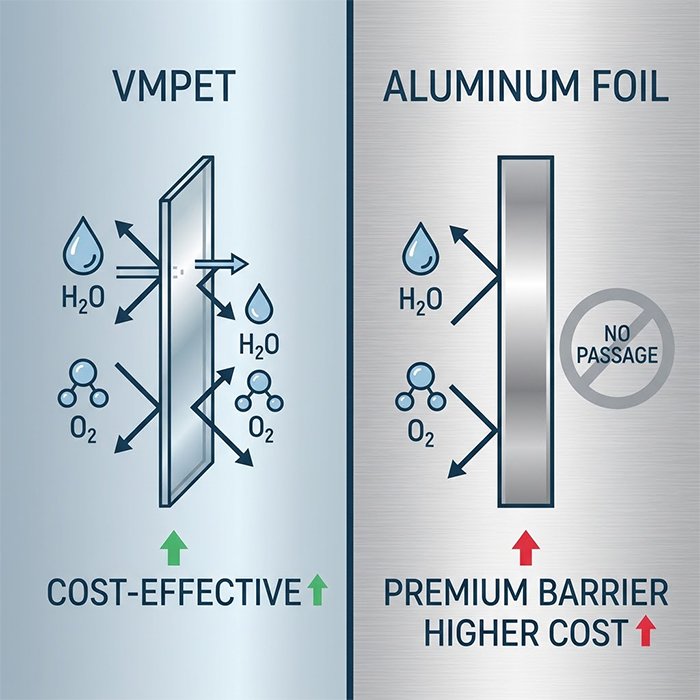
In the world of flexible packaging, few material decisions carry as much weight as the choice between aluminum foil (AL) and vacuum-metallized PET (VMPET). Whether protecting sensitive electronic components from humidity, preserving the freshness of high-fat pet food, or extending the shelf life of pharmaceuticals, moisture and oxygen barriers are the critical line of defense against product degradation. This article examines the fundamental differences between these two materials across three key barrier dimensions—moisture, oxygen, and light—and evaluates which offers superior cost-effectiveness for various applications.
2. Understanding the Materials
What is Aluminum Foil (AL)?
Aluminum foil is a continuous sheet of pure aluminum produced by rolling—typically 6.5 to 9 micrometers thick for flexible packaging applications. The metal is physically compressed into a dense, continuous layer with virtually no pores or gaps. This uninterrupted metallic structure is the foundation of its exceptional barrier performance.
What is VMPET Material?
VMPET is produced by vacuum-depositing a thin layer of aluminum—typically just 30 to 80 nanometers thick—onto a PET (polyester) film substrate. Unlike aluminum foil, which is a separate metal layer, VMPET’s aluminum is a surface coating measured in nanometers rather than micrometers. This fundamental structural difference—continuous metal sheet vs. nano-scale coating on plastic—drives every performance distinction between the two materials.
3. Barrier Properties: Head-to-Head Comparison
3.1 Moisture Barrier (WVTR – Water Vapor Transmission Rate)
Water vapor transmission rate (WVTR) measures how much moisture vapor can pass through a material over 24 hours, typically expressed in g/m²/day at 38°C and 90% relative humidity.
| Material | WVTR (g/m²/day) | Performance Level |
|---|---|---|
| Aluminum Foil (9μm) | < 0.01 | ⭐ Near-absolute (Hermetic) |
| VMPET (High OD ≥2.8) | 0.2 – 0.8 | ✅ Excellent |
| VMPET (Standard OD ~2.0) | 0.5 – 1.5 | ✅ Good |
| VMPET (Entry-level) | 1.0 – 3.0 | ⚠️ Moderate |
The Gap: Aluminum foil’s moisture barrier is typically one to two orders of magnitude better than VMPET.
3.2 Oxygen Barrier (OTR – Oxygen Transmission Rate)
Oxygen transmission rate (OTR) measures how much oxygen passes through a material, typically in cc/m²/day at 23°C.
| Material | OTR (cc/m²/day) | Performance Level |
|---|---|---|
| Aluminum Foil | < 0.01 | ⭐ Zero transmission (Gold standard) |
| VMPET (OD 2.8) | 0.3 – 1.0 | ✅ Very Good |
| VMPET (Standard) | 0.8 – 2.0 | ✅ Good |
| VMPET (Poor-quality) | 10 – 50+ | ❌ Poor (Micro-pores present) |
The Critical Difference: VMPET’s oxygen barrier is compromised by its fundamental structure. As a physical vapor-deposited layer, VMPET contains micro-pores and pinholes that allow oxygen permeation.
3.3 Light Barrier (Opacity & UV Protection)
| Material | Opacity | UV Protection |
|---|---|---|
| Aluminum Foil | 100% (Absolute) | Complete blockage |
| VMPET (High quality) | 98 – 99% | Excellent (>95% blocked) |
The Gap: While VMPET is “almost” opaque, aluminum foil is completely opaque. For products where even minimal light exposure causes degradation, this difference can be decisive.
4. The Hidden Variable: Flex Cracking
One of the most critical yet often overlooked differences between these materials is their behavior under mechanical stress.
- Aluminum Foil: Prone to pinhole formation and cracking when flexed. Research shows foil laminates can fail to retain their oxygen barrier after 270 cycles of flexing.
- VMPET: Demonstrates better flex-crack resistance than aluminum foil in many applications. The PET substrate provides flexibility, and while the coating can crack, it generally withstands normal handling better.
The Trade-off: Foil starts with superior barrier properties but can lose them through mechanical damage. VMPET starts with inferior barrier properties but tends to maintain them better under normal flexing conditions.
5. Cost-Effectiveness Analysis
5.1 Raw Material & Processing Cost
The cost difference between the two materials is structural, not marginal.
| Factor | Aluminum Foil | VMPET |
|---|---|---|
| Aluminum Consumption | 7,000 – 9,000 nm | 30 – 80 nm (100x less) |
| Relative Cost Index | 1.0 (Baseline) | 0.3 – 0.5 |
| Weight/Density | Heavier (Higher shipping cost) | Lighter (Lower logistics cost) |
Real-World Insight: A mid-sized pet food brand producing 5 million bags annually can save 8–12% in total packaging material costs by switching from foil to VMPET—before even accounting for logistics savings. For mass-market applications, the cost differential can be 30–80% depending on thickness and laminate design.
5.2 When Cost Savings Can Backfire
The cost-effectiveness equation changes when product requirements demand absolute barrier performance. A single product recall due to moisture damage or oxidation can wipe out years of material savings. For high-value products with long shelf-life requirements, the incremental cost of aluminum foil is often negligible compared to the value being protected.
6. Practical Selection Guide
✅ Choose Aluminum Foil When:
- Shelf life >12 months – Hermetic barrier required
- Extreme moisture sensitivity – WVTR <0.01 required
- Extreme oxygen sensitivity – OTR <0.01 required
- Retort/sterilization – Withstands 121°C processing
- Premium/export products – Maximum protection justifies cost
- Absolute light blocking – 100% opacity needed
✅ Choose VMPET When:
- Shelf life 6–18 months – Sufficient with good QC
- Moderate barrier sufficient – Most dry foods and snacks
- Cost sensitivity – 1/3 to 1/2 the cost of foil
- Weight reduction needed – Lighter than foil laminates
- High flexibility required – Better flex-crack resistance
- Mass-market production – Cost-efficient for large volumes
7. Conclusion
The choice between VMPET and aluminum foil is not about which material is “better”—it is about which material is right for the application.
Key Takeaway: The barrier gap between these materials is not incremental—it is measured in orders of magnitude. Aluminum foil’s oxygen and moisture barriers are typically one to two magnitudes better than any vacuum-coated polymer film. This is not a subtle difference; it is the difference between “almost impermeable” and “functionally impermeable.”
For procurement and engineering teams, the decision ultimately rests on a single question: What is the cost of failure? For high-value pharmaceuticals, premium coffees, or mission-critical electronics, the answer justifies aluminum foil. For everyday consumer goods, VMPET offers the optimal balance of performance and cost—provided that quality control ensures metallization standards (OD ≥2.8) are met.



Leave a Reply