




📑 Table of Contents
- 1 What is Electrostatic Discharge? (Technical Definition & Physics)
- 2 What Is ESD in Computers? (Invisible Threat & Vulnerable Components)
- 3 What Causes Electrostatic Discharge? (Primary Mechanisms & Common Sources)
- 4 How to Eliminate ESD Risk (Individual, Workspace, & Industry-Level Protection)
- 5 Common Myths About ESD (Debunked)
- 6 Frequently Asked Questions (FAQ)
That sudden jolt you feel when you touch a doorknob after walking across a carpeted floor isn’t just an annoyance—it’s a phenomenon that can destroy sensitive electronics worth thousands of dollars. Yet remarkably, many people working with computers and electronic devices remain unaware of the true nature of electrostatic discharge (ESD), its causes, or the simple steps that can prevent catastrophic damage.
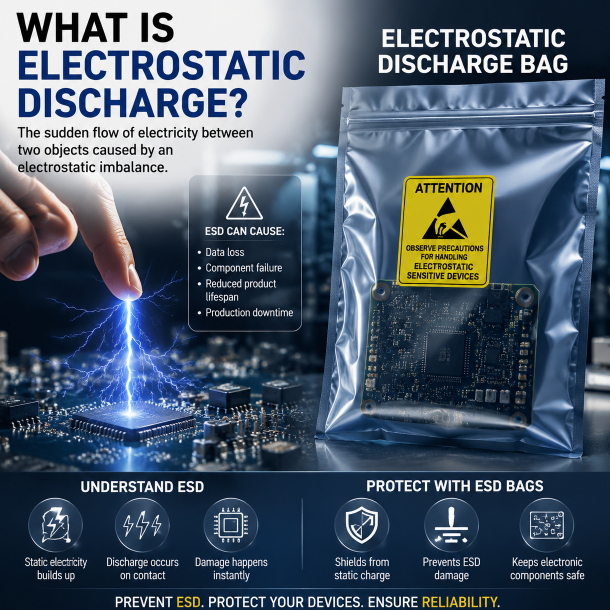
This guide provides a comprehensive, expert-driven exploration of ESD—from the physics of static electricity to practical prevention strategies used in professional electronics manufacturing. Whether you’re a computer technician, an electronics hobbyist, or simply someone who wants to understand why you should ground yourself before opening a computer case, this article delivers the depth of knowledge you need.
1. What Is Electrostatic Discharge?
The Technical Definition
Electrostatic discharge (ESD) is the sudden transfer of static charge between objects at different electrostatic potentials. The Electrostatic Discharge Association (ESDA)—a nonprofit organization dedicated exclusively to this phenomenon—defines ESD as “the rapid, spontaneous transfer of electrostatic charge induced by a high electrostatic field”.
In simpler terms, ESD is the near-immediate release of a built-up static charge. When two objects with different electrical charges come into contact or close proximity, electrons rapidly jump from one to the other to balance the charge difference. This creates what most people recognize as a static shock—a miniature lightning bolt traveling between objects.
How Static Charge Builds Up
All matter is composed of atoms, each containing positively charged protons and negatively charged electrons. Under normal conditions, atoms are electrically neutral. However, when two different materials come into contact and then separate, electrons can transfer from one material to the other. One surface gains electrons (becoming negatively charged), while the other loses electrons (becoming positively charged).
This process is known as the triboelectric effect. The triboelectric series ranks materials by their tendency to gain or lose electrons: materials farther apart on this series generate more charge when separated.
⚡ Everyday examples include:
- Walking across a carpeted floor (shoes separating from carpet fibers)
- Removing a polyester jacket over a wool sweater
- Combing your hair with a plastic comb
- Unwrapping electronic components from plastic packaging
The Physics of an ESD Event
An ESD event occurs through a four-stage process:
- Charge generation—static electricity accumulates on a surface.
- Charge transfer—the charged object approaches or contacts another object.
- Device response—the discharge current flows through the electronic component.
- Device failure—the component is damaged or destroyed.
The human body can generate static voltages as high as 20,000 volts simply by walking on a carpeted floor.
2. What Is Electrostatic Discharge in Computers?
The Invisible Threat to Electronics
ESD poses a serious threat to electronic devices, including microcircuits, transistors, diodes, disk drives, magnetic recording heads, and sensors. Most electronic companies regard all semiconductor devices as ESD-sensitive because of the damage ESD can cause.
The human body can safely store and conduct small amounts of electricity, but it is far more resilient against sudden changes in electric charge than the delicate circuits of a computer. Even a static discharge you can’t feel—less than 3,500 volts—can damage components that are sensitive to as little as 30 volts.
Why Modern Components Are More Vulnerable
As the electronics industry continues to demand lower power consumption and increased density, semiconductor components have become more susceptible to ESD damage. Thinner gate oxide layers in modern integrated circuits can be punctured by ESD events that would have been harmless to older, larger components.
Types of ESD Damage
- Catastrophic Failure (≈20%): Causes an immediate and complete loss of device functionality (e.g., a memory DIMM fails instantly).
- Latent (Intermittent) Failure: Damage is not immediately apparent but causes intermittent problems or shortens lifespan. The component works initially but fails unpredictably weeks later.
Most Vulnerable Computer Components
- CMOS Circuits: Possess very thin layers of insulation.
- Hard Disk Drives / SSDs: ESD can damage data or blow apart tiny circuit paths.
- Peripheral Devices: Even mice and keyboards can be damaged.
- Processors, Memory Modules & Motherboards: Contain thousands of ESD-sensitive transistors.
3. What Causes Electrostatic Discharge?
Primary Mechanisms
- Triboelectric Charging (Most Common): Charges generated when two materials contact and separate.
- Electrical Breakdown: A spark jumps across a gap when the electric field exceeds the dielectric strength of air.
- Short Circuit: Direct contact between charged objects equalizes potential.
Common Sources of ESD
- The Human Body: The most common source. Walking on carpet can generate up to 20,000V.
- Work Surfaces & Furniture: Unprotected benches and chairs generate charges.
- Packaging Materials: Plastic bags and bubble wrap generate static when opened.
- Clothing: Synthetic fabrics like polyester and nylon generate significant static.
- Environmental Factors: Low humidity (<30%) dramatically increases risk.
4. What Should Be Done to Eliminate Electrostatic Discharge Risk?
Eliminating ESD risk requires a multi-layered approach. Here is a professional breakdown of the most effective measures.
A. Individual-Level Protection (For Hobbyists & Technicians)
- Wear an Anti-Static Wrist Strap: Connect to an unpainted metal surface on the chassis.
- Remove Metallic Jewelry: Bracelets, rings, and watches before handling components.
- Use Anti-Static Mats: Place a grounded mat on your workbench.
- Keep Components in Anti-Static Bags: Store safely until installation.
- Maintain Proper Humidity: Keep relative humidity between 40-60%.
- Touch Grounded Metal First: Discharge yourself before handling any component.
B. Workspace-Level Protection
- Anti-Static Flooring: Grounds anyone standing on it.
- Conductive Workbenches & Chairs: Integral to the ESD Protected Area (EPA).
- Ionizers: Neutralize static charges in the atmosphere.
- Humidity Control Systems: Install humidifiers in production halls.
C. Industry-Level Protection (Professional Environments)
- ESD Control Programs (ANSI/ESD S20.20): Assign a program manager, develop training, verify compliance.
- On-Chip ESD Protection: Manufacturers incorporate protection circuits at I/O pins.
- External Protection (TVS Diodes): Response times under one nanosecond protect ICs.
- Comprehensive Training: Combine classroom theory with hands-on practice.
💡 The Three-Way Strategy (IEEE)
1. Preventing ESD altogether (materials, grounding).
2. Preventing coupling of ESD noise (shielding).
3. Increasing inherent noise immunity (design).
5. Common Myths About ESD (Debunked)
❌ Myth: “I’ve never damaged anything.”
✅ Reality: Much ESD damage is latent—you can’t see or feel it.
❌ Myth: “No shock means no damage.”
✅ Reality: You can’t feel shocks below ~3,500V, but components die at ~30V.
❌ Myth: “Anti-static bags protect after opening.”
✅ Reality: They only protect components inside. Once opened, they are exposed.
❌ Myth: “Touching the case is enough.”
✅ Reality: Only works if plugged in. A wrist strap provides continuous grounding.
6. Frequently Asked Questions (FAQ)
🔹 What is electrostatic discharge in simple terms?
It is the sudden flow of electricity between two electrically charged objects caused by contact, an electrical short, or dielectric breakdown. It’s essentially a miniature lightning bolt that occurs when static electricity is released.
🔹 What causes electrostatic discharge in computers?
It is primarily caused by the human body (walking, moving) generating triboelectric charges, low humidity environments, and handling sensitive components without proper grounding or ESD-safe packaging.
🔹 How do I eliminate ESD risk when building a PC?
Wear a grounding wrist strap connected to the metal chassis, work on an anti-static mat, maintain 40-60% humidity, avoid synthetic clothing, and always touch bare metal before handling components.
🔹 Can ESD damage a computer even if it’s turned off?
Absolutely. ESD damages the physical circuitry (semiconductors). The device does not need to be powered on for the static charge to destroy the delicate internal transistors and gate oxides.
🔹 What is the difference between ESD and a power surge?
ESD is a high-voltage, low-energy static discharge (often from a human body) lasting nanoseconds. A power surge is a high-energy, low-voltage spike coming through the mains power supply (like lightning or grid switching).
Conclusion
Electrostatic discharge is far more than an occasional annoyance—it’s a significant threat to electronic components that can cause immediate failures or insidious latent damage. Understanding what ESD is, how it occurs, and how to prevent it is essential for anyone who handles electronic devices.
The good news is that ESD is entirely preventable. With proper grounding, appropriate workspace preparation, and awareness of static-generating activities, you can virtually eliminate the risk of ESD damage. Whether you’re a professional electronics technician, an IT administrator, or a hobbyist building your own computer, the simple steps outlined in this guide will protect your valuable equipment from the invisible threat of electrostatic discharge.
Remember: You can’t see ESD, you often can’t feel it, but it can destroy your electronics in an instant. Take the precautions seriously—your components will thank you.



Leave a Reply